To Atiku and Tinubu, There Was No Subsidy in the First Place
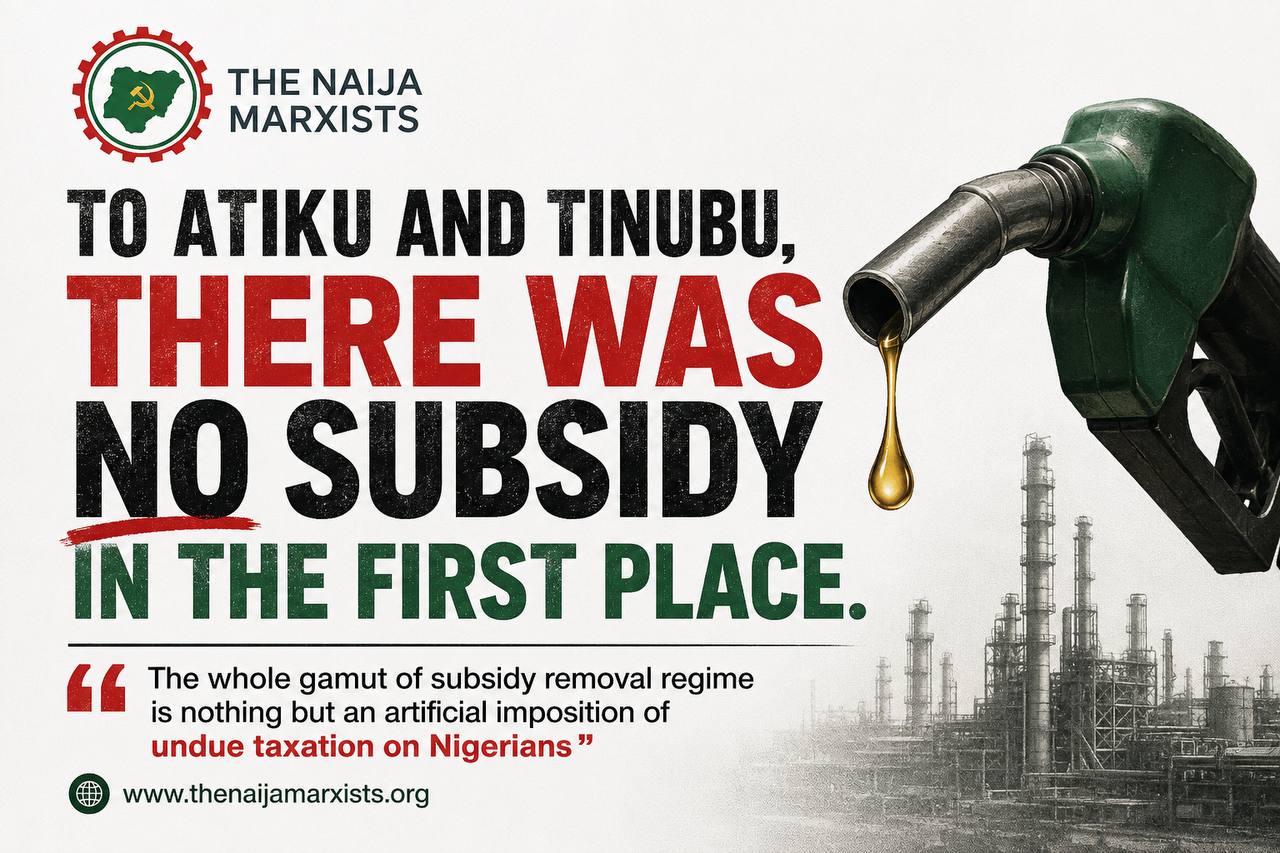
“The whole gamut of subsidy removal regime is nothing but an artificial imposition of undue taxation on Nigerians.”
As the campaign for the 2027 presidential election gathers momentum, the ADC presidential candidate, Atiku Abubakar, unveiled his campaign manifesto and pledged to restore the subsidy on petroleum products. The announcement triggered a wave of reactions from the Presidency, with President Bola Ahmed Tinubu, who championed the removal of the fuel subsidy, criticising Atiku’s proposal. Tinubu argued that Atiku’s position on fuel subsidies reflects a fundamental misunderstanding of the Nigerian economy.
Atiku’s policy announcement and the subsequent reaction from the Tinubu administration reignited the debate over fuel subsidies, bringing to the forefront the long-standing and unresolved question of whether a fuel subsidy actually exists in the first place.
Was there really a subsidy in the first place? The answer is NO. The language of ‘subsidy removal’ has often been used to justify price increases, particularly within the structural-adjustment framework promoted by the IMF and World Bank from the 1980s onward, when structural adjustment programmes (SAP) were presented as a solution and the removal of price controls and subsidies formed part of the broader package of market-oriented reforms.
A central challenge is the limited public scrutiny applied to the subsidy debate. Too often, even well-educated Nigerians have accepted official claims without conducting independent research or asking sufficiently critical questions. At what point in Nigeria’s history did the term ‘subsidy’ appear in people’s consciousness or national lexicon? It emerged in the 1980s when the Nigerian government was negotiating loans with the IMF and World Bank, as part of the Structural Adjustment Programme (SAP), and became widespread in Nigerian political discourse thereafter.
The Origins of the Subsidy Narrative
Structural adjustment was premised on the argument that the government was effectively subsidising the standard of living of its citizens by keeping the prices of essential goods and public services below their international market value. During the negotiations over Nigeria’s SAP, the IMF and World Bank compared the prices of electricity, fuel and other public services with international market rates, argued that they were artificially low, and prescribed cost-reflective pricing, deregulation and the commercialisation of public utilities to relieve the state of its financial obligations and free up fiscal capacity for servicing Nigeria’s external debts.
In practice this shifted the cost of essential goods and services from the state to citizens, requiring Nigerians to pay more for electricity, fuel and other services despite far lower domestic incomes than those prevailing in the international markets used as benchmarks.
The IMF and World Bank could not impose austerity in Nigeria without the connivance of Nigerian government officials. The immediate problem was how to implement their prescriptions without public resistance, and the framing of ‘subsidy’ was constructed to tell the public that existing prices were artificially low and therefore required adjustment. When the IBB military regime held a national debate in 1985–86, Nigerians rejected the proposed IMF loan. Babangida’s government then introduced the Structural Adjustment Programme in 1986 as a “home-grown” programme, while drawing heavily on the same IMF and World Bank prescriptions: naira devaluation, deregulation and liberalisation, the privatisation and commercialisation of state enterprises, and the reduction of subsidies and price controls.
In effect, the regime told Nigerians that the Federal Government had been subsidising the public and the economy, and that these subsidies would be phased out so people would pay a fairer share of the cost of social services. The reforms abolished the commodity marketing boards and allowed agricultural and commodity prices to rise. Yet during the 1960s and early 1980s, the official term in public services and the national budget was GOVERNMENT SUBVENTIONS.
Successive administrations, especially the Sani Abacha regime, accepted the narrative that there was a ‘subsidy’ regime. Together with the late Professor Sam Aluko, the Abacha regime suspended part of the SAP by fixing the exchange rate and reintroducing controls over foreign exchange, interest rates and prices. Prices were also raised substantially, particularly petroleum prices, with new petroleum prices announced in October 1994.
The Price Increases: A Condensed History
The table below shows how the notion of ‘subsidy’ has been used to increase the price of fuel from 1985 to 2026.
| Year / Date | Petrol (PMS) Price Per Litre | % Increment |
|---|---|---|
| 1985 | ₦0.20 (20 kobo) | pre-SAP price |
| 31 Mar. 1986 | ₦0.395 (39.5 kobo) | +97.5% |
| 1993 | ₦3.25 | +364% |
| 04 Oct. 1994 | ₦11.00 | +238.46% |
| 2012 | ₦145 | — |
| 2023 | ₦617 | +325.52% |
| Dec. 2024 | ₦1,189.12 | +77.00% |
| May 2026 | ₦1,596.25 | +52.20% |
This is a condensed table. The years shown are landmarks marking the major jumps and the regimes behind them; the omitted years saw prices rise too, not hold steady. The table shows that there was nothing like a subsidy.
The smokescreen called ‘subsidy’ was a political narrative concocted to justify price increases in social services. Since 2001 the Federal Government has privatised NITEL, NEPA and others, and the four refineries are moribund and unworking, which means the government long ago stopped giving subventions to these state corporations. If there was no subvention, especially to the NNPC, there ought to have been savings for the state. Yet the price of petroleum products continues to rise. The scam called ‘subsidy’ therefore has nothing to do with the price of petroleum products.
It is indirect taxation dressed up as reform, an attempt to force Nigerians to pay the international market price for fuel, as prescribed by the IMF and World Bank.
The Consequence: Erosion of Workers’ Incomes
The consequence of this indirect taxation has been the erosion of workers’ incomes and the destruction of ordinary people’s living standards. As the prices of essential goods and services rose while wages failed to keep pace, workers suffered a substantial decline in their real purchasing power. Consider the relationship between the minimum wage and the cost of fuel: a worker earning the ₦70,000 monthly minimum wage may struggle to fill a car’s tank without spending a substantial share of that income, the pressure created when domestic fuel prices are aligned with international market rates despite the much lower incomes earned by many Nigerians.
In relative adjustment to the size and nature of the Nigerian economy, the domestic fuel price should not be more than ₦250 per litre.
Why Both Atiku and Tinubu Are Mistaken
Atiku’s acceptance of the claim that a fuel subsidy existed reflects, in my view, a limited understanding of the economic and political assumptions underpinning the subsidy debate. His proposal to restore the subsidy, because the purported savings from its removal have not improved Nigerians’ lives, fails to address the more fundamental question of whether the subsidy existed as officially described.
If the dollar value of Nigeria’s crude-oil sales between 2003 and 2024 is compared with the cost of imported petroleum products over the same period, any remaining surplus would cast serious doubt on the official subsidy narrative. These figures would suggest that the alleged subsidy was never real, only a misleading construction.
To Tinubu, the government he led knew there was no subsidy, yet as a strong adherent of IMF and World Bank policies he was determined to implement their recommendations to the letter, seemingly because he saw no alternative. He has always been known for imposing economic burdens on the people of Lagos, and he appears determined to squeeze Nigerians even further.
Nigeria cannot afford a second term of the Tinubu administration. And if Tinubu rigged the presidential election and used fraudulent results to declare himself president, then perhaps the time has come for Nigerians to move to the arena of revolution. Nigerians cannot continue to be economically enslaved in their own country by a tiny, elitist class representing less than 1 percent of the population.