Ibrahim Traoré and the Unfinished Burkinabè Revolution
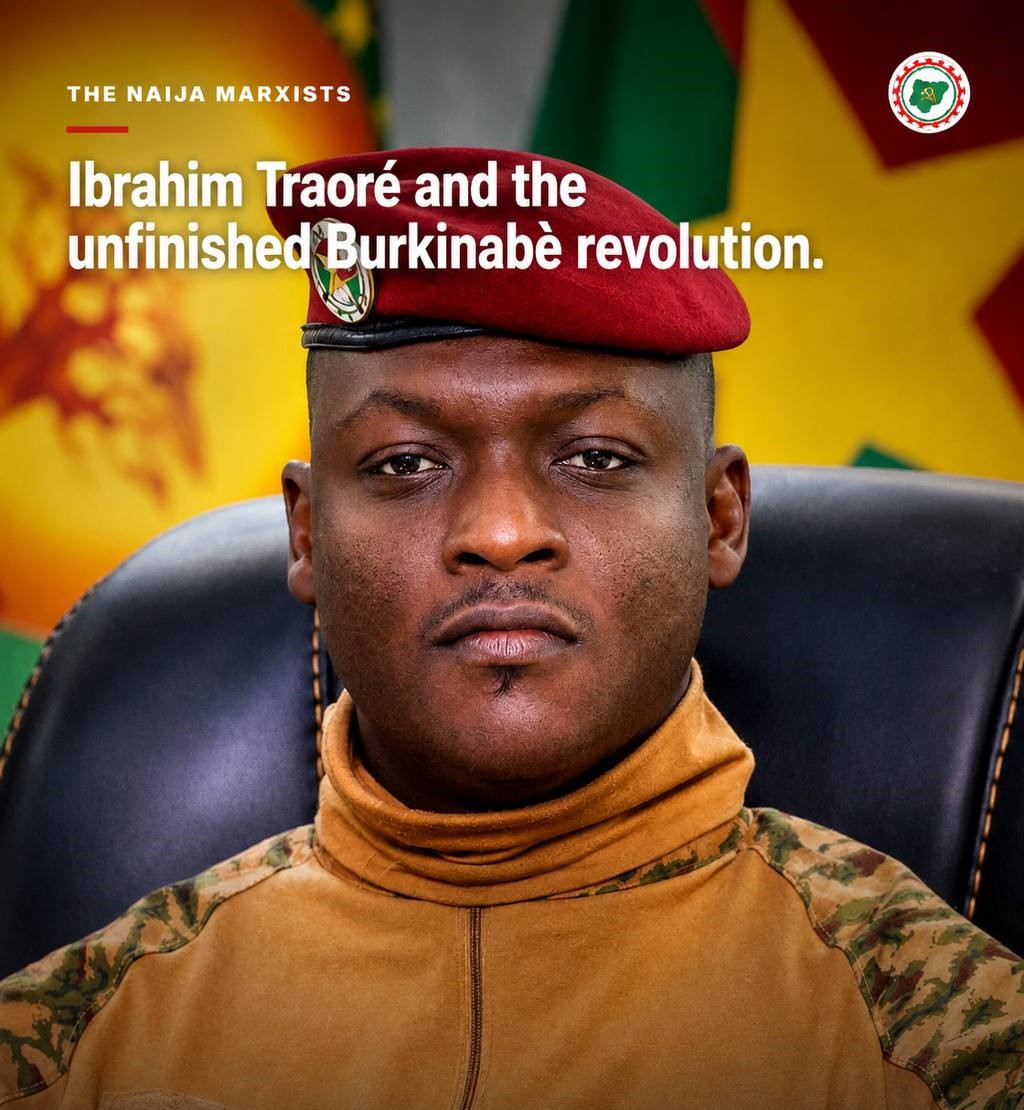
Few African personalities in recent years have generated as much enthusiasm as that of Captain Ibrahim Traoré. For many young Africans he has come to represent something larger than the man himself: the desire to break with the humiliating political and economic relations that have kept Africa subordinate to imperialism. Around Traoré has grown an enormous popular enthusiasm that now runs ahead of the man himself. Cast online as a new Sankara, he is made to embody hopes far beyond his government’s actual achievements, amplified by manipulated and AI-generated material. Yet this fervour reflects a real continental hunger for a force capable of breaking with imperialism.
These sentiments are not misplaced, and Traoré’s rise cannot be understood simply as the emergence of a charismatic military officer. The mass rejection of French imperialist domination was already a material force in Burkinabè society before the coup that brought him into power. For at least a year before the September 2022 coup led by Traoré, the Burkinabè working class and youth had already been protesting against the French military presence. In November 2021, people in several towns went further and physically blocked a French military convoy on its way to Niger. They were met with tear gas from the Burkinabè army and warning shots from the French.
Traoré’s rise emerged from that tension and the profound crisis of Burkina Faso’s neocolonial order, characterized by persistent economic dependence despite formal independence, immense mineral wealth alongside widespread poverty, and years of jihadist insurgency, territorial loss and displacement compounded by the failure of predecessor governments and their foreign military partners. His promise to reclaim national sovereignty and place the struggle against the insurgency under Burkinabè control therefore found a genuine popular base, one the people themselves had already put into motion.
The question before us is not whether this anti-imperialist sentiment is legitimate, but where it can lead. For the revolution to be completed, the struggle against imperialism must confront the neocolonial capitalist relations that reproduce exploitation within Burkina Faso itself and place the working class at the centre of that struggle.
The Anti-Imperialist Measures of the Traoré Government
The Traoré government has undoubtedly disrupted important aspects of Burkina Faso’s previous relationship with France. French military forces have been expelled, the country has broken with longstanding military arrangements with Paris, and the Alliance of Sahel States has pursued greater political independence from the French-led regional order.
There have also been some changes in the mining sector. The 2024 Mining Code increased the state’s free participation in new mining projects from 10% to 15%, tightening oversight and expanding the state acquisition of assets. Driven by these actions and record global gold prices, the country produced 94 tons of gold in 2025, generating 776 billion FCFA in direct budget revenue by the end of December. Gold is the central strategic resource of Burkina Faso’s economy.
These are changes, and they should be recognised as such, but they should NOT be confused with a rupture with imperialism as a system nor as steps towards socialism, and it is essential we understand why.
Nationalisation or State Regulations Are Not Equal to Socialism
The distinction that MUST be recognised is between state ownership and workers’ ownership. A mine can pass from a foreign corporation to a Burkinabè government company, and even replace the foreign ownership and participation arrangement, yet it does not by itself abolish capitalist relations of production. Under capitalism, production is achieved through wage labour and commodity exchange, that is, the exploitation of workers by those who own and control the property and the state. If gold remains produced for profit and world markets, and if the surplus is allocated by a bureaucracy above society rather than by the producers themselves, the decisive social relation of capitalist exploitation remains intact.
Nationalisation can increase national economic sovereignty while preserving capitalism, in this case, neocolonial capitalism. The decisive question is who concretely holds the title to the mines, who commands production and appropriates the surplus. Under the present arrangement, that surplus remains mediated by the state apparatus, domestic capital, foreign debtors, new foreign partners and the wider international financial system.
This contradiction is visible in fiscal, monetary and property relations. Burkina Faso remains embedded in the Union Économique et Monétaire Ouest-Africaine (UEMOA) monetary order and still uses the CFA franc. The government has yet to establish monetary sovereignty over one of the fundamental instruments through which an economy is managed, its currency.
Additionally, foreign capital remains heavily present in the mining sector, while the new framework combines greater state participation with continued private ownership. The 2024 Mining Code raised the state’s free participation in new mining projects from a mere 10 to 15 percent, alongside higher royalties and provisions for further state or national private participation. In 2024, the state did take over the Boungou and Wahgnion mines through Société de Participation Minière du Burkina (SOPAMIB), though even this was no expropriation but a negotiated buyout that paid Endeavour Mining $60 million and the company retained a royalty. Most major mines remain in the hands of foreign capital, including Canadian, Australian and Russian-linked companies.
The same pattern appears in the banking sector. BNP Paribas and Société Générale have retreated from Burkina Faso, but their assets have not passed into democratic public ownership. They have been acquired by Vista Bank, associated with the Burkinabè-American financier Simon Tiemtoré.
Rather than freeing mining revenue for public needs, the IMF-backed programme combines higher tax collection with tighter limits on government spending. Public-sector wage spending is expected to fall from 9.0% of GDP in 2023 to 7.8% in 2026, while the government is required to keep its budget deficit within WAEMU limits. This means Burkina Faso has not escaped imperialist economic control, as external fiscal and monetary rules still limit how the country’s wealth can be used.
What we are witnessing is a mere window dressing of the state’s position within the international economy, a substitution of one imperialist partner with another, not a socialist transformation of that economy. Workers’ control cannot mean consultation with a state company after decisions have been made; it means elected and recallable committees of public-sector workers, and workers, peasants, displaced people and local communities having access to the books, power over production targets and investment, and representation in a national democratic plan.
So, Who Benefits from the Current Arrangement?
To answer this question, we must first examine the class composition of the country. The mining sector employs fewer than 20,000 people, under 0.3% of the labour force, yet generates 75 to 80% of exports and roughly a fifth of the country’s public revenue. This is an enclave economy: a strategically vital sector with a tiny direct workforce, embedded in global finance and commodity markets, while the mass of the population lives through agriculture, informal work, precarious urban services or displacement. Alongside stands a domestic ruling bloc composed of the military apparatus, state bureaucrats and domestic capitalists.
A Burkinabè mineworker and a Burkinabè capitalist can both want France out, but they do not share the same interest in what happens after France leaves. The capitalist seeks a share of the national surplus, which is produced through a relation inherently based on the worker’s exploitation, and the current arrangement under the junta continues to grant them just that. On the other hand, the worker needs control over said surplus, wages, public services, investment and the conditions of life.
Traoré’s regime has not made fundamental changes that could end imperialist control and exploitation of the Burkinabè working masses.
Poverty, War and Class Rule
The latest full household survey places the national poverty rate at 43.2% in 2021/22, or about 9.5 million people. At the $8.30-a-day threshold, 90.4% of the population fell below the line in 2021. Rural poverty stood at 52.7%, more than twice the urban rate of 24.5%. There has been a more recent improvement with strong harvests and lower inflation contributing to a reduction in extreme poverty, with an estimation of a fall to 34.6% in 2025. This eases hardship, but it does not alter land ownership, informal labour, the allocation of mining rents or control over investment.
The same contradiction defines the war. Burkina Faso’s jihadist insurgency did not grow simply because people are poor, but through the interaction of poverty, state absence, rural abandonment, land and pastoral conflict, ethnic hierarchy, corruption, armed repression and regional networks. In many areas, communities experienced the state not as a provider of schools, water, land justice or healthcare, but as distant administrators, predatory officials or armed force.
More than 2.1 million people remain forcibly displaced by the war between the state and jihadist forces. This is not a secondary humanitarian question. Displacement dismantles livelihoods, disrupts education, turns young people toward survival strategies and leaves communities vulnerable to recruitment by armed groups or incorporation into state-aligned militias. A militarised campaign through the Volunteers for the Defense of the Homeland mobilisation alone cannot solve conditions that are social, economic and political at their root.
Neither French nor Russian military assistance and tutelage can resolve these social conditions from above. Lasting security requires public works, food security, land and pastoral justice, schools, healthcare, jobs, compensation for displaced people and democratic accountability for armed forces and militias. The defence of the countryside must rest under the democratic authority of organised workers, peasants and communities, because the economic and security questions are one. This means that the armed force, however it is centralised and commanded, must belong to the organised workers and peasants as well.
The Strategic Power of the Burkinabè Working Class
Despite their conditions, the Burkinabè working class has repeatedly proven itself the decisive agent in transforming social relations. In 1966 a general strike and mass demonstrations brought down Maurice Yaméogo; in 1983 the revolutionary government of Thomas Sankara emerged from a broader tradition of popular and military mobilisation; in 2014 those same trade unions and mass protests overthrew Blaise Compaoré; and in 2015 mass civilian mobilisation again led by trade unions and civic committees defeated the Diendéré coup. These episodes demonstrate a consistent pattern: when the Burkinabè working class organises independently and acts as a political subject rather than a petitioner to the state, it becomes a decisive force capable of transforming political relations.
This is why the current suppression of workers’ organisations matters so much. Under Traoré’s government the space for independent working-class organisation has been steadily narrowed. Demonstrations are restricted, critics of the government are silenced, and trade union activists face intimidation. This cannot be waved away as unfortunate or excused as wartime necessity. Given the country’s history, the narrowing of autonomous class politics prevents the social force capable of carrying anti-imperialism beyond capitalist nationalism.
The Marxist Position
Our position is neither unconditional support nor liberal denunciation of the junta. We defend every genuine measure that weakens imperialist domination and Burkina Faso’s right to control its own resources. But the revolution cannot be completed through national sovereignty alone. The continued reliance on the UEMOA monetary order, the CFA franc and IMF-constrained fiscal policy reveals the limits of the present rupture: the state is capturing more national wealth without breaking with the structures that constrain its use. These limits are NOT accidental; they reflect the interests of a ruling bloc whose power remains rooted in the military-state apparatus rather than democratic control by workers and peasants.
The working class cannot surrender its political rights to a military apparatus in the name of anti-imperialism. The right to organise unions, strike, publish a workers’ press, form independent workers’ and peasants’ parties, and openly criticise the government is not a demand for Western tutelage or a return to the old comprador order. It is the minimum political condition for the masses to determine the direction of the anti-imperialist struggle themselves.
This means fighting to carry the national rupture beyond the limits of the present regime through the demand for a sovereign constituent assembly, elected by and accountable to the Burkinabè people, and independent of the military command, the transition charter and domestic and foreign capital. Such an assembly must have full authority to determine the country’s political, social and economic future: the ownership of land and strategic resources, the rights of national minorities, the organisation of the armed forces and a democratic plan for reconstruction. For this process to be genuinely sovereign, workers and peasants must have the unrestricted right to organise, strike, publish and form their own parties, unions and democratic organisations, independent of the state. This is not a call to restore the discredited bourgeois parties that administered neocolonial dependence, but to open the struggle for the Burkinabè people to reorganise society on their own terms. That struggle must extend to the nationalisation of the mines, banks and commanding heights without compensation and under workers’ control, placing the country’s recovered wealth at the service of a democratic socialist plan to reconstruct the countryside, end displacement and attack the material roots of jihadist war.
Burkina Faso cannot complete this transformation alone. Workers and poor people across West Africa face the same problems of imperialism, war and capitalist exploitation. For Nigerians and other Africans inspired by Burkina Faso, the lesson is therefore not to search for our own Traoré, but to build the independent organisations capable of leading the exploited masses. The unfinished Burkinabè rupture can become part of an African socialist revolution, but only by moving beyond the replacement of foreign capital with national capital, military rule over popular classes, and national sovereignty confined within capitalism. The wealth of Africa must belong to those who produce it. Only then can the continent uproot the material conditions of war, defeat imperialism in practice and complete the revolution that formal independence left unfinished.