Lessons from the Osun State Election
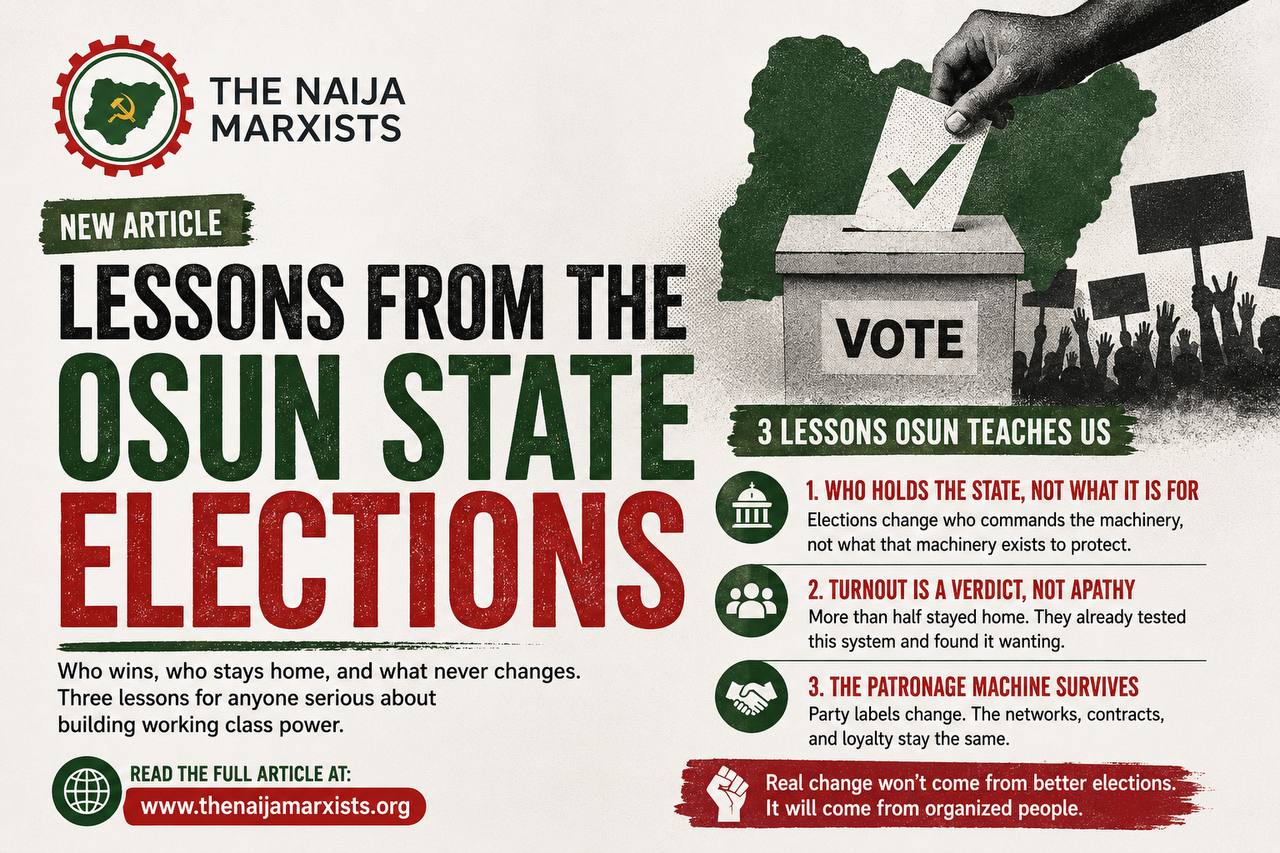
On August 15 the Independent National Electoral Commission declared Ademola Adeleke winner of a second term as governor of Osun State, this time on the platform of Accord rather than the Peoples Democratic Party that first put him in office in 2022. He defeated the All Progressives Congress candidate, Bola Oyebamiji, by roughly sixty six thousand votes out of just under one million cast. For anyone trying to work out what an election actually changes under a state built to serve capital, Osun offers three clear lessons.
An Election Changes Who Holds the State, Not What the State Is For
A state is armed bodies of men with the facade of a bureaucracy added, sworn to defend the ability of elites to expropriate and impoverish the masses, and a vote decides who commands that machinery for a term. It does not decide what the machinery exists to protect. Osun has cycled through three governors and effectively two party blocs since 2010, Rauf Aregbesola of the APC, Gboyega Oyetola of the APC, and now Adeleke, who moved from PDP to Accord, and the machinery each of them inherited stayed remarkably intact across every handover. Oyetola took over Aregbesola’s civil service and spent much of his term paying down the debt that administration had left behind. Adeleke took over Oyetola’s civil service and moved quickly to review the permanent secretaries and traditional ruler appointments Oyetola had made on his way out, not because the bureaucracy itself was new, but because control over who sits inside it is what actually changes hands at a handover. The police command in Osogbo answered to the same federal structure through all three administrations. What changed each time was which coalition of contractors, appointees, and loyalists got first call on the machine’s patronage. Learning to separate who commands the machine from what the machine is for is the first habit anyone reading an election through Marxist eyes needs to build.
Falling Turnout Is a Verdict, Not Apathy
The second lesson sits in the turnout numbers, which usually get less attention than the horse race itself. INEC recorded 2,339,233 registered voters, the highest in Osun’s history, and a turnout of only 43.2 percent, continuing a two decade slide from over fifty percent in 2003 and 2014, through 46.2 percent in 2018, down to 42.4 percent in 2022. More than half the people who collected a Permanent Voter Card did not use it. Universal suffrage under a state like this was never a device that measures or delivers majority rule. At best it is a gauge of how organized working people are at a given moment.
Read that way, a falling turnout is not apathy waiting on a voter education jingle, which is the explanation INEC’s Resident Electoral Commissioner offered ahead of the vote. It is a verdict, delivered by hundreds of thousands of Osun workers and market women, on what three governorships of participation have actually gotten them. Anyone organizing in Osun today is not fighting apathy. They are talking to people who already tested this apparatus and found it wanting.
The Patronage Network Survives Any Change of Party Label
The third lesson is that the patronage network holding the state together survives a change of party label intact, because it was never built around the label to begin with. Reporting from polling units recorded BVAS machines malfunctioning, vote buying happening in the open, and at least one Accord party member caught holding multiple Permanent Voter Cards, none of it unique to Accord or to Osun. Adeleke’s own move from PDP to Accord shows the same thing from another angle. He did not leave one party for another because Accord promised a different relationship between the state and Osun’s working people. He left because the PDP structure had stopped serving his faction’s hold on the same machine he already controlled. The Ataoja of Osogbo’s public endorsement of Adeleke, reportedly made under pressure, is not really a story about one traditional ruler. It shows what happens when a state’s patronage machinery runs on loyalty networks that absorb whoever can still deliver votes, whatever title they hold. The label on top changes. The threads underneath do not.
The Task Ahead
Put together, these lessons point in one direction. Accord’s first governorship win reshuffles which political family controls Osun’s contracts for the next four years, and that reshuffle is not nothing to the people who depend on it. But nobody who commands Osun’s armed and administrative bodies, or who can recall them, changed on August 15. And the falling turnout is not a gap waiting on a better candidate next cycle. It is a constituency that has already tried voting and moved past it.
For anyone serious about building working class power in Osun, or anywhere else in Nigeria, the task is not to wait for a cleaner election. It is to go and organize the people who have already withdrawn from this one. The Naija Marxists humbly provide that platform.