Nigeria is Suffering from Capitalism
In searching for a solution to Nigeria’s problems, many pundits and analysts insist that the country should embrace capitalism more fully, open itself to foreign capital, and remake itself in the image of the United States. Others look at the same country and call it socialist, pointing to the land and mineral resources held by the government, the state oil company, and the subsidies on education and electricity. However, both miss what actually decides the character of an economy, which is determined by a different question: who owns and controls production in Nigeria, and who takes the surplus that labour creates.
This question is as old as human society. To survive, humans must enter into relationships with nature, and these interactions shape how we produce our means of subsistence: food, clothing, shelter, and other necessities. Together, these relationships constitute the mode of production, the way society organizes itself to meet its material needs. Over millennia, humanity has moved through various modes of production, from primitive communalism and slavery to feudalism and capitalism, and in nearly all of them the surplus has been distributed unevenly: the vast majority toil to produce it, while a small minority appropriates and controls it.
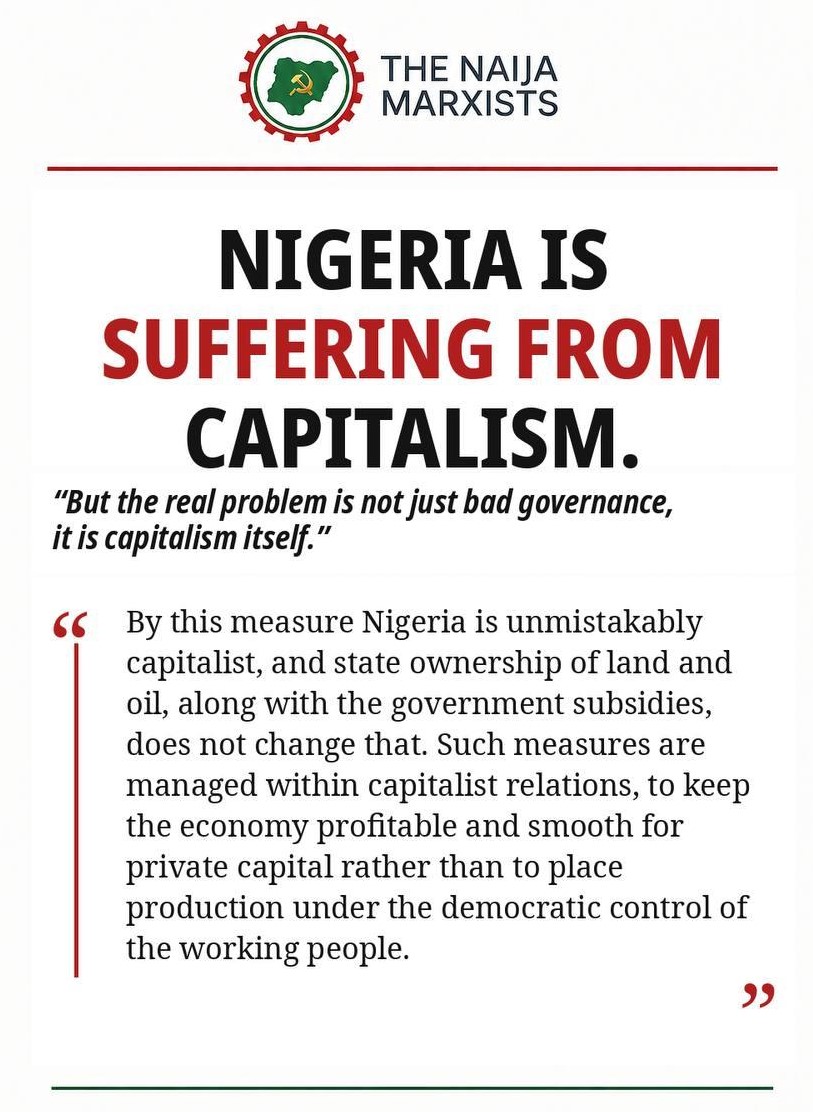
One class operates the forces of production; another class claims the surplus. By this measure Nigeria is unmistakably capitalist, and state ownership of land and oil, along with the government subsidies, does not change that. Such measures are managed within capitalist relations, to keep the economy profitable and smooth for private capital rather than to place production under the democratic control of the working people.
Although Nigeria is not as developed as the core capitalist countries, it is part and parcel of the global capitalist economy. Capitalism builds industry only where the industry pays profit fastest and safest, and in Nigeria that is oil rent, trade and banking, so capital gathers where the money already is and leaves the productive forces undeveloped.
Nigeria’s Capitalist Foundation
Nigeria’s production is characterized by its market-oriented commodity production, where most goods and services are made for exchange and profit rather than for the needs of society. Labour power, the ability to work itself, becomes a commodity valued only for its capacity to generate profit for the employer, which is a key reason for the unemployment crisis today, as capital constantly seeks to cut labour costs or automate in order to raise profit. Alongside this, the means of production are privately owned and concentrated in the hands of a tiny bourgeoisie, local and transnational, while the vast majority of Nigerians own little more than their labour power. Companies like Shell, Dangote Group and BUA Cement control the extraction, production and distribution of the wealth drawn from Nigeria’s natural resources, wealth transformed by workers.
Those workers, for their part, own only their labour power, which they must sell to the bourgeoisie in order to survive. The worker receives a wage, but this wage is only a fraction of the value their labour creates, and the rest is appropriated as profit by the owners. A national minimum wage of ₦70,000 a month, worth only a few dozen dollars, stands against the billions accumulated by those who own the means of production.
The shape of this economy is unmistakable. Roughly 88% of Nigeria’s export earnings in 2024 came from oil and gas, leaving the country dependent on a single resource whose surplus flows to a handful of multinationals and a domestic rentier elite. That elite lives off oil rents, contracts, import licences and financial speculation rather than building up Nigeria’s productive forces, which is why decades of oil wealth have left the majority poorer.
In addition, the majority survives at the margins of this system. Over 80% of employed Nigerians work in the informal sector, as street vendors, transport workers, artisans and small traders, without contracts, social protection or union cover. The informal sector is part of the capitalist order rather than a world apart from it, a reserve of cheap, casual labour that capital draws on to depress wages and cheapen its inputs, while forcing the risks of survival onto workers themselves.
The State and the Illusion of Reform
The Nigerian state, in both its colonial origins and post-independence trajectory, has been organised to protect and reproduce this capitalist logic. Its policies, laws, and security apparatus are oriented toward ensuring the conditions for accumulation for the minority, often at the expense of the majority. The Nigerian state was largely created by colonial capitalism to protect the private property of colonial capitalists, maintain the extraction of raw materials, and keep Nigeria as an open market for foreign products. Today the same logic persists, and the state mediates between domestic and foreign capital, granting licences, deregulating banking and telecoms, and carrying out programmes demanded by the World Bank and the IMF.
The reforms pressed since 2023, the removal of the “fuel subsidy” and the floating of the naira, are clear examples. They were carried out to restore investor confidence and protect accumulation. They however drove inflation above 30% and pushed millions more into hardship, so that by the government’s own count 133 million Nigerians, 63% of the population, now live in multidimensional poverty. The books were balanced for capital and paid for by the working class.
We are constantly fed the comforting narrative that Nigeria’s problems are simply the result of “bad government” or corrupt individuals. And indeed, the political managers play an awfully destructive role in running the country. But the real problem is not just bad governance, it is capitalism itself. A political economy centred on extraction for the world market, where capital’s sole concern is export and accumulation, is fundamentally indifferent to the development of a Nigeria where our labour directly benefits us and our communities. No amount of “good governance” reform can resolve this contradiction, because the state itself is structurally bound to serve capital. To believe otherwise is to mistake the symptom for the disease.
A Communist Future
If capitalism is the root of Nigeria’s crisis and the state is its instrument, then reform is not enough. Only a fundamental divorce can suffice.
From the belly of capitalism, a higher form of society lies in wait: communism. It is the logical extension of humanity’s capacity to produce abundance, now organised for the benefit of all rather than the profit of a few. A communist Nigeria would socialise the ownership of the means of production, so that the oil, gas, minerals, and factories belong to the Nigerian people as a whole and not to a handful of billionaires or foreign corporations. Freed from the pursuit of private profit, production will be planned to develop the country: to build the industry capital refused to build, to put the millions who have no work to work, and to feed, house and educate our people from our own wealth.
This is not a utopian fantasy. The productive forces already exist, and Nigeria has more than enough wealth to feed, house, and educate every citizen. The only obstacle is the capitalist relations of production that prevent that wealth from being used for the common good.
The Path Forward
Achieving such a society requires more than good intentions or spontaneous uprising. It demands a rigorous understanding of Marxist theory, not as a buzzword or a dogma, but as a living, revolutionary science of social transformation: a method for understanding society in its totality, uncovering its contradictions, and identifying the forces capable of overcoming them.
Theory alone cannot change the world. Without revolutionary organisation, analysis remains abstract and power remains in the hands of the ruling class. A class does not seize power without an instrument, and that instrument is a revolutionary party rooted in the workers and the poor, armed with a clear programme and disciplined for the fight.
The Naija Marxists are building that movement. We are organising workers and youth across Nigeria to defeat capitalism and imperialism, and build a healthier, more just, and truly independent Nigeria.
The enemy is powerful and the task is immense, but history is on the side of the working class, because the working class has nothing to lose but its chains, and a world to gain.