Subsidy's Shambolic Return
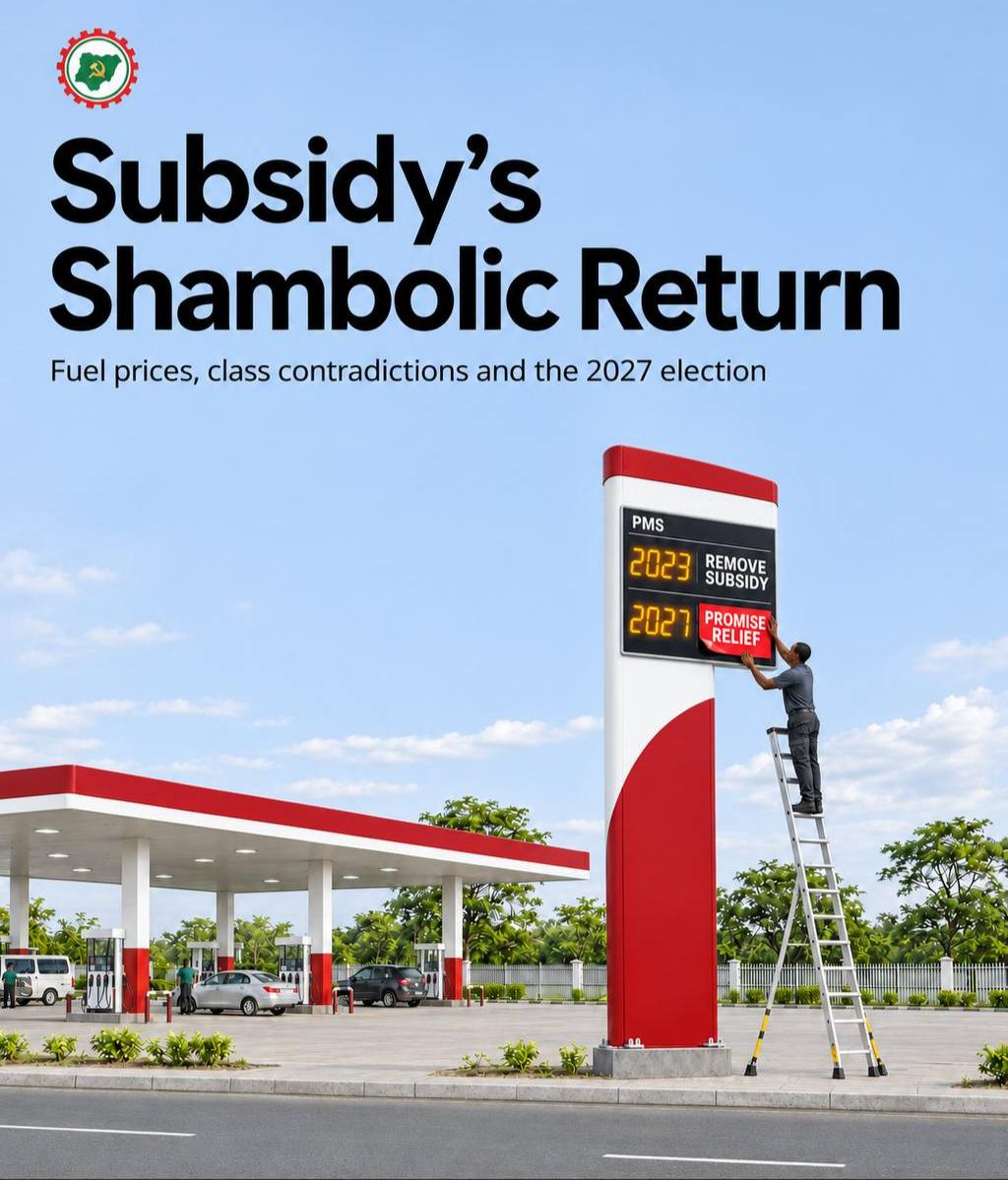
In 2023, Tinubu, Atiku and Obi agreed on one thing: Nigeria’s petrol subsidy had to go. They differed over how it should be removed, but all three accepted the argument that the government could no longer afford it. Three years later, Atiku and Obi are promising forms of restoration, while Tinubu’s government is offering temporary relief without abandoning deregulation.
What has changed? Certainly not the economic interests of Nigeria’s ruling class. What has changed is the political difficulty of defending a policy whose consequences millions of Nigerians experience daily. The Tinubu regime claimed that government saved money by removing the subsidy, but workers have borne a huge burden through higher transport costs, food prices and declining purchasing power. With another election approaching, the politicians who defended removal are discovering that its consequences cannot simply be explained away.
A subsidy that has not returned
Despite recent announcements, the old petrol subsidy has not been restored. On 8 October, the government announced temporary relief through NNPC, which subsequently extended its ₦66-per-litre promotional discount until 31 October. Unlike the former subsidy, which they claimed used public funds to keep petrol below its commercial supply cost, this arrangement is limited to NNPC outlets and reportedly funded through retail margins.
Even obtaining the discount has proved difficult. Motorists have complained about smartphone requirements, problems using the application and limited participating outlets. For workers already struggling with transport costs, such temporary relief offers little security. The Tinubu regime is now defending two contradictory positions. It insists that petrol prices should follow market conditions while intervening to soften the consequences of those same conditions. Having presented “subsidy removal” as an economic necessity, it is discovering that leaving Nigerians exposed to rising prices carries considerable political costs.
From agreement to electoral disagreement
In August 2026, Atiku promised to restore the petrol subsidy and questioned what had happened to the money supposedly saved since its removal. Obi’s reversal has been even more striking. At the Nigerian Bar Association conference in August, he defended removal and argued that mismanagement did not justify reversing it. Yet by late September, speaking alongside Kwankwaso in Sokoto, he promised restoration after addressing corruption.
These politicians are not necessarily proposing a return to the exact arrangement that existed before 2023. But the contradiction remains. What they once defended as necessary economic reform is now being reconsidered because of its political consequences. This is more than personal inconsistency. Atiku and Obi recognise an opportunity to turn popular anger into electoral support. Both promise relief while presenting themselves as better managers of Nigeria’s economy. Their disagreement concerns how much support the state should provide, how it should be administered and who should govern. Neither has proposed a fundamental change in the capitalist ownership of Nigeria’s economy.
The northern setting is particularly important. Nigeria’s 2022 multidimensional poverty report found that 65% of the country’s multidimensionally poor population lived in the North, with poverty affecting approximately 91% of Sokoto’s population. These figures predate Tinubu, but they show the conditions into which subsequent fuel-price increases entered. Petrol prices affect even those who do not own vehicles. Farmers must transport produce, traders move goods between markets and workers pay to reach their workplaces. Higher transport costs therefore deepen existing poverty. Atiku and Obi are seeking to turn this hardship into political support, although northern workers and poor farmers do not necessarily share the interests of the region’s wealthy politicians and businesspeople.
The ruling class and its contradictions
The hardship produced by Tinubu’s IMF economic programme has been evident since its introduction. Nigerians were promised that “subsidy removal” (which is actually mere price hikes) would free public money for development, attract investment and eventually improve living standards. Instead, millions have experienced rising prices and wages that buy increasingly less. The NNPC discount reflects the difficulty of defending these policies. Tinubu cannot easily abandon deregulation without undermining his government’s economic programme, but maintaining it without relief risks deepening popular anger. Meanwhile, Atiku and Obi criticise the consequences of a policy they previously supported, insisting that better management can make it work. The ruling class is therefore divided over how to respond to the hardship its economic policies have produced, not over the capitalist system itself. Replacing one politician with another does not necessarily change whose interests the economy serves.
When hardship becomes political struggle
There is an important Marxist lesson here. Economic hardship does not automatically produce revolutionary consciousness. Workers may endure rising prices, protest, support opposition parties or become discouraged. What matters is whether their experiences lead them to question the economic system itself and whether organisations exist to turn that understanding into collective action. This is where dialectics becomes important. Repeated increases in fuel prices, transport fares and food costs accumulate over time. Eventually, workers who initially regarded these increases as temporary sacrifices would begin questioning why wages remain stagnant, why public resources do not improve their lives and why successive governments pursue similar policies.
This is the relationship between quantitative change and qualitative transformation. But the outcome is not predetermined. Popular anger can bring another ruling-class politician to power, be suppressed through repression or develop into independent working-class struggle. The decisive question is who organises that anger and towards what political objective. The subsidy controversy shows that policies once defended as economically unavoidable can become politically difficult to sustain. But this does not mean the ruling class is about to collapse. Its different factions can disagree, compromise and reorganise their policies while preserving the same economic system.
For Marxists, the task is to connect the immediate struggle for affordable fuel, higher wages and better living conditions with the struggle over ownership and political power. Petroleum is essential to transport, agriculture, manufacturing and everyday life. Its production, refining and distribution cannot remain questions of private profit if the needs of Nigerian workers are to determine how the industry operates. Ultimately, genuine change requires an independent revolutionary working-class movement capable of challenging the economic and political power of Nigeria’s capitalist class, rather than placing its hopes in another politician promising to manage the same system differently.
The question is not simply which politician will make petrol cheaper, but which class will control Nigeria’s resources and determine how they are used.